INTRODUCTION:-
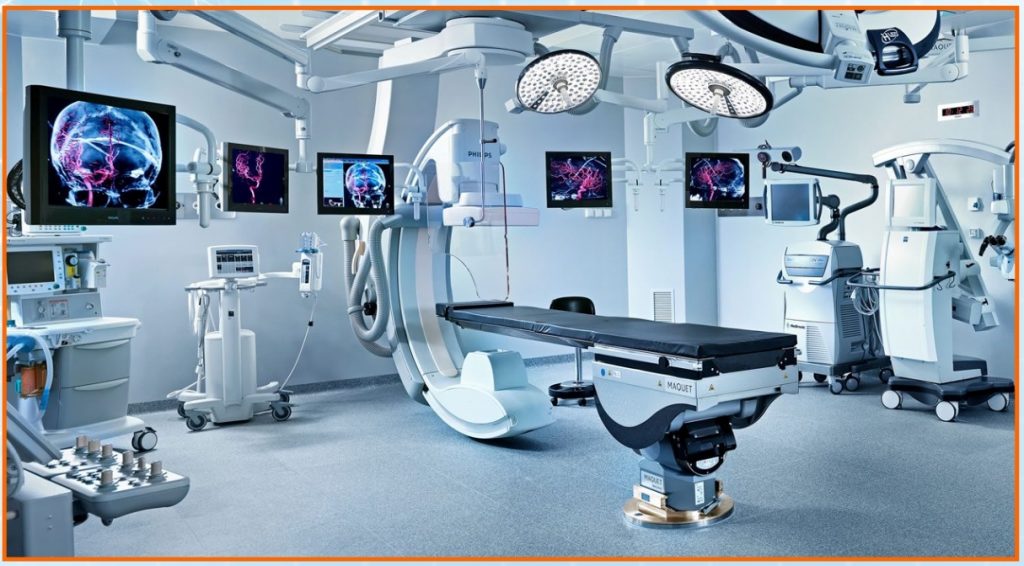
Operation theatre are units in the health care organization which was concerned with manipulation of human body for the purpose of treatment or diagnosis of health disorders.
While establishing an OT following points should be considered:-
*Location within the hospital
*Quantity
*Design
*Equipment requirement.
DESIGN PARAMETERS FOR SETTING UP OT:-
*Avoid unrelated hospital traffic
*Avoid out door noise
*Keep a provision for future expansion
*Easy access to department like ICU, CSSD,surgical ward.
*Sliding doors
*Smooth but non slippery floors
*Ceiling & walls painted with washable paint
*Knee, foot or elbow operated taps
*High efficiency autoclave
*Emergency communication system which can be activated with out the use of hand.
*Radiology film illuminators.
LOCATION WITH IN HOSPITAL:-
*Keep away from contaminated ward
*Avoid crowing in the OT area.
*Minimization of issue related to surgical supplies.
*Easy scheduling of surgeries.
*Near to surgical ward & ICU, radiology, pathology, blood bank & CSSD.
SIZE OF OT:-
An ideal general OT have a minimum clear area of 360 sq.ft (18ft*20ft)
But specialised OT such as cardiothoracic, orthopaedic neuro surgery etc require large area to accommodate additional equipments such as microscope, heart lung machine, ECG machine & for large surgical team.
QUANTITY OF OT:-
No of OT depends upon various factors such as:-
1. Cost benefit consideration:- The availability of the finance would dictate the number of OTs a health care facility which may also based on revenues & expenses of the hospital.
2. Patient load & disease occurrence:- the number & type of patient received & expected in the health care facility would determine what type & how many operating room would be required in hospital
3. Availability of space:- if less space available in the hospital then a central OT with multiple procedure performing capacity have to be developed but if adequate space is available separate OT such as eye OT, CTVS, neuro & gynae can be prepared.
4. No of surgical bed & speciality:- A hospital with more no of beds & multi speciality would required more no of OT as compared to to a hospital with lesser no of bed.
5. Average length of stay of hospital patient: – the no of OT calculated in the hospital on the basis of some of the above parameters by using the following equation.
NO OF SURGICAL BEDS * OCCUPANCY RATE *FULL WORKING DAYS IN A YEAR (APROX260)
/AVERAGE LENGTH OF STAY
Thus for a hospital with 500 beds, number of surgical beds could be 125.if he average length of stay for surgical patients is 10 days & occupancy is 80% then no of OT required would be:-
125*80*260 / 10 = 125*0.8*260=2600 surgeries/ year or about 10 surgeries /day
So in 8 hour 3-4 surgeries can be performed in each room & necessitating at least 3 rooms for given above pt load.
OT DESIGN:-
The basic principle of designing the OT is that the patient & staff should flow functionally & aseptically from & to the OT.
Any OT should include the following minimum service in its design:-
*Major operating room
*Recovery room
*Sub sterilizing area/ work area.
*Sterile instrument supply & storage area
*Scrub area
*Clean up area
*Male dressing room & toilet
*Female dressing room & toilet
*Nurse station/ work area
*Wheel chair & stretcher area.
ZONE:-
OT area divided in to zone for maximum protection against contamination. There are 3 zone in OT, those are:-
1. Zone I (The outer zone)
2. Zone II (middle/ intermediate zone)
3. Zone III ( inner/ most sterile zone)
1. Zone I:- (outer zone)
*This area is comparatively most unsterile zone.
*This area also known as interchange zone.
*This area include changing room, dressing room, patient reception, locker, surgeons, theatre incharge office, conference room, class room & refreshment area.
2. Zone II:- Middle/ intermediate zone:-
*This is the semi restricted area which do not permit personnel with out OT room attire.
*This area include recovery room, pre-anesthesia room, clean store room, ot sterilization equipment such as autoclave.
3. Zone III:- ( inner/ most sterile zone(
*This is the restricted area where operation performed.
*The area include scrubbing area with adequate number of sinks or through with elbow or foot controlled taps, operation room.
CLASSIFICATION OF OT:-
OT can be classified in to various categories :-
1. On the basis of extent of surgery involved:-
a. Minor OT:- Hear simple procedure are performed & most of the procedures done under local anaesthesia. Ex- suturing, dressing, casting & minor debridement.
b. Major OT:- these OT are well equipped with all the arrangement for general anaesthesia & spiral anaesthesia required for surgeries.
2. On the basis of type of service provided:-
a. Out patient OT:- located in the out patient department & involve the surgeries performed on outpatient basis. Usually minor surgeries performed under local anaesthesia.
b. Inpatient OT:- located away from the out patient department & patient have to admit in inpatient department.
3. Decentralized :- here several ot are there but each OT dedicated to a particular surgical speciality or located near the speciality or located near the speciality department.
Ex- neuro surgery
Orthopedic
Ctvs
Eye
Plastic surgery
General surgery OT
Gynae OT
Renal /urology OT
Transplant OT
Radiotherapy OT
4. On the basis of urgency of situation:-
a. Emergency OT:- here there is no planned surgeries & do not need prior list of patient to be operated. These OTs function like emergency to have ready to all time to handle any surgery which is to perform urgently.
b. Elective OT:- These are regular OTs of a hospital in which the routein planned surgeries are performed as per the list of patient decided at least one day prior to the surgery.
POLICIES AND PROCEDURES OF AN OT:-
Operation theatre should have clear cut policies & procedures in written format which also called standing orders. These standing orders deals with:-
*Function of OT.
*Duties & responsibility of doctors, nurses, technician.
*Check list for preparing the OT for surgeries.
*Posting of doctors, nurses, their working hours & responsibilities for emergency work.
*Maintenance of records for surgical procedures.
*Method of aseptic procedures
Methods of aseptic technique to be followed in OT.
*Maintenance of sterility in different zone.
*Technique of preparation for surgery by nurse & doctor
*Cleaning of OT & schedule for fumigation.
*Maintenance of equipment
*Disposal of medical weast
*Safety policies & procedures.
STAFFING PATTERN & MEMBERS OF OT TEAM:-
Benefits of good staffing norms:-
*Improve the patient outcome
*Maintain patient & staff safety
*Lower mortality rate.
*Increase OT efficiency.
*Reduce patient waiting time for surgery
*Enhance professional satisfaction
*Reduce OT case cancellation
*Balanced work load.
Essential of staffing in an OT:-
*Consideration should be given to the following while designing staff for an OT.
*Each personal is qualified, skilled & experienced to assume the responsibilities, authority, accountability & functions of the position.
*Professional qualification are validated, including evidence of professional registration/ license, where applicable, prior to employment.
*An organised medical & nursing staff shall be responsible for the quality of patient care & for the ethical conduct & professional practice of its members.
*Willingness of the staff to work long hours in standing position.
FUNCTIONS OF VARIOUS STAFFS:-
1. Registered nurse:-
*Implement patient care during the perioperative period.
*She act as a patient advocate throughout the Intraoperative period.
*She also maintain the patient safety, privacy, dignity & confidentiality.
*Scrub nurse follow the designated scrub procedure, remain in sterile field & assist doctor in procedure. She do ongoing assessment of patient condition & respond quickly to any changes.
*The circulatory nurse remain in the unsterile field also don’t were gown & gloves. They supply needed equipments from out side.
2. Surgeon:-
*Physician who perform the surgical procedure.
*The surgeon primarily responsible for:-Assess the patient condition, decide surgical intervention needed, preoperative testing, check patient safety & manage in all phase.
3. Assistant surgeon:-
*He assist the physician in whole procedure.
*The assistant usually hold retractor to expose surgical area & assist with suturing.
*He can perform some portion of surgery under surgeon’s supervision.
4. Anaesthesia care provider:-
Anaesthesiologist is the person who administer & monitor anaesthesia. Manage pain, maintain vital sign.